From Hospital Recovery to Regional Impact
286-bed acute care hospital; foundation for a four-hospital, approximately $750 million Kern County system
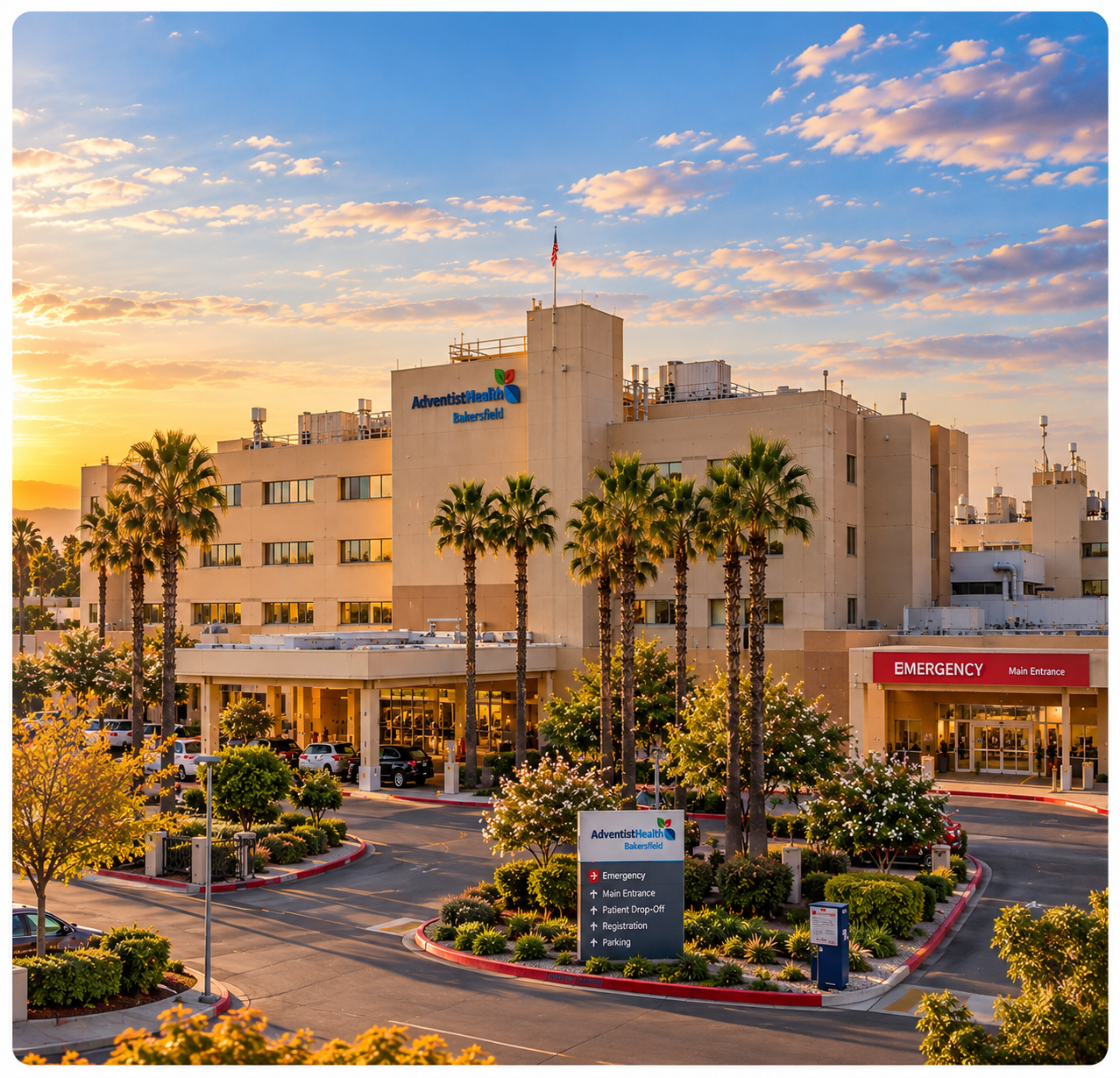
When I arrived in Bakersfield in 2013, San Joaquin Community Hospital was a major healthcare institution with strong demand, an established mission and an important relationship with Kaiser Permanente.
It was also an organization facing significant challenges. The hospital had experienced serious regulatory issues under prior leadership. Expenses had been growing faster than revenue. Physician alignment lagged competitors. And the hospital was operating near the limits of its physical capacity, with several inpatient units routinely operating above 95% occupancy and an emergency department handling more than 71,000 annual visits in just 22 beds.
Independent capacity analysis later concluded that the hospital was already critically close to exceeding its available capacity.
The immediate priorities were clear: strengthen quality, rebuild confidence, improve operating performance and restore financial momentum.
But the opportunity was larger than fixing a hospital. The objective was to build an organization strong enough to become the foundation of a regional healthcare system.
Growth presented an unusual problem: we didn't have empty beds waiting to be filled. Independent analyses found demand already exceeding sustainable capacity in several areas, particularly obstetrics, intensive care and telemetry. Long-term expansion was necessary, but new hospitals take years to develop.
So we also needed to create capacity inside the organization we already had.
One example was case management. Rather than treating case management simply as an expense to minimize, we increased resources and reduced caseloads. Departmental expense went up. System performance improved.
Average length of stay declined from approximately 4.17 to 3.72 days, while readmission performance reached the top quartile. Better throughput helped reduce ED boarding and ambulance handoff delays while releasing inpatient capacity.
The goal isn't to minimize the cost of every department. It's to optimize the performance of the entire system.
We organized the transformation around four interconnected priorities: engage our people and physicians; improve the clinical product; grow the market; and strengthen financial performance.
The sequence mattered. Better engagement should produce better execution. Better execution should improve quality and patient experience. Better care should strengthen physician and community confidence. Greater confidence should support growth. And growth combined with operating discipline should generate the financial strength required to reinvest.
By 2016, that strategy had evolved into an explicit vision for Adventist Health Kern County to become a wellness-driven, comprehensive healthcare delivery system—indispensable to Bakersfield and the rural communities of Kern County.
This wasn't a collection of initiatives. It was an operating system.
At the beginning of the strategy, Dignity Health operated three hospitals in the market to Adventist Health's one. Our response was not simply to add another hospital. We engaged the Board in defining a broader model of care: a comprehensive delivery system that could serve people across the continuum.
The strategic vision explicitly called for affordable access to health plans that incentivized wellness, a clinically integrated network of primary and specialty care providers, comprehensive outpatient services, chronic disease management, expanded inpatient capacity with multiple hospitals, and post-acute care services.
The goal was not to make the hospital bigger for its own sake. It was to build the components of a healthcare delivery system around a strong clinical and economic anchor. Community preference and scale would allow the organization to serve more people, improve community health and generate the financial strength to keep expanding services.
Quality had to come first. The hospital had experienced significant CMS regulatory challenges before my arrival. Addressing those issues was necessary not only for compliance, but for restoring confidence among employees, physicians, the Board and the community.
We strengthened accountability, applied Lean improvement methods and made clinical reliability a visible organizational priority.
The hospital moved from a Leapfrog C to an A for patient safety. Healthgrades recognized it as a Distinguished Hospital for Clinical Excellence for three consecutive years, placing it among the top 5% of hospitals nationally. U.S. News also recognized the hospital among the top 10% nationally for selected areas of common care.
The organization was no longer trying simply to recover. It was learning how to perform at a high level.
Adventist Health already had a strong mission tradition expressed through the idea of Sacred Work. We expanded what that meant operationally.
If every person is sacred, then the outcomes affecting those people matter too. Quality was Sacred Work. Patient experience was Sacred Work. Reducing unnecessary delays was Sacred Work. Responsible stewardship was Sacred Work. Growth that expanded access to needed care was Sacred Work.
Leadership rounding, employee forums, unit-level improvement plans, physician rounding, leadership development and greater transparency around results helped translate that philosophy into daily operations.
Employee engagement increased from the 5th to the 58th percentile over the transformation period. Administrative physician engagement increased from the 19th percentile in 2014 to the 65th percentile in 2016, while a separate measure of employed-physician engagement ultimately reached the 90th percentile. Voluntary employee turnover declined to 7.2% in 2016.
Performance is one of the ways mission becomes tangible.
Because inpatient capacity was limited, indiscriminately adding volume would have made the problem worse. Our 2014 planning therefore established a deliberate bridge strategy.
We prioritized higher-acuity services that patients in the region needed but often had to leave the market to receive. We expanded ambulatory capacity. We strengthened physician alignment. And we developed relationships with regional hospitals that could connect patients with tertiary services in Bakersfield.
Brain & Spine volume increased from 399 to 486. Orthopedic surgery increased from 1,591 to 2,276. Radiation oncology treatments increased from 4,924 to 9,043. Medical oncology increased from 3,159 to 6,468. The longer-term Cancer Center trajectory increased from approximately 1,847 treatments in 2013 to 8,941 in 2016.
The employed primary-care network ultimately grew to approximately 40 providers. Overall market share increased from approximately 29.8% to 32.7%. Top-of-mind consumer preference increased from 22.6% in 2014 to 30.8% in 2016.
At the beginning of the transformation, San Joaquin Community Hospital was already a substantial organization. In 2013, annual revenue was approximately $335 million, with a $1.1 million net loss.
By 2017, annual revenue had reached approximately $417.4 million—an increase of roughly $83 million, or 24.8%. Expenses were approximately $389.0 million and net income was positive $28.4 million.
The improvement was not the product of a single cost-reduction initiative. It came from changing the underlying economics of the organization: improving throughput, strengthening labor productivity, growing higher-value clinical services, expanding ambulatory care and physician alignment, and maintaining discipline around operating expense.
Financial performance wasn't separate from the strategy. It was evidence that the strategy was working.
The hospital's capacity constraints weren't temporary. Independent planning projected substantial additional inpatient demand and supported development of approximately 143–150 additional beds.
We evaluated expansion of the existing campus and development of a second hospital in southwest Bakersfield. The second-campus strategy offered much more than beds: geographic access in one of Bakersfield's fastest-growing areas, deeper alignment with Kaiser Permanente, and a purpose-designed platform for future growth. The organization ultimately secured corporate approval for an approximately $350 million second hospital campus.
At the same time, we were looking beyond Bakersfield. Our regional strategy contemplated a network of hospitals and communities across Kern County, with care delivered locally where possible and patients connected to higher-acuity services in Bakersfield when necessary.
During my tenure, I facilitated acquisition discussions with the boards of Tehachapi Valley Hospital, Bakersfield Heart Hospital and the community hospital in Delano. Together with the existing Bakersfield hospital, those organizations ultimately became the four-hospital, approximately $750 million footprint Adventist Health operates across Kern County today.
We also developed regional affiliations, including with Ridgecrest Regional Hospital, extending the strategy beyond owned facilities and strengthening Bakersfield's role as a regional referral center.
Not every transaction closed during my tenure. But the market strategy, relationships and acquisition work were already underway. The objective was deliberate: move from a single hospital to a comprehensive regional delivery system with the scale, geographic reach and continuum of services necessary to serve Kern County.
The strategy created the foundation for what is now a four-hospital system across Kern County.
Looking back, the most important result wasn't any single number. It was the way the improvements began reinforcing one another.
Better quality rebuilt confidence. Greater confidence helped engage employees and physicians. More engaged teams executed more effectively. Better execution improved throughput and created capacity. Greater clinical capability and access supported growth. Growth combined with operating discipline strengthened financial performance. And financial strength created the ability to reinvest—in people, physicians, services, facilities and communities.
Growth, quality, culture and financial performance aren't separate leadership agendas. In a well-led organization, they become part of the same operating system.
In Bakersfield, strengthening that operating system ultimately made something much larger possible: the transition from improving one hospital to building the foundation for a comprehensive regional healthcare delivery system.